
Trees
Chamaecyparis obtusa 'Wells Special'
Wells Special Hinoki cypress
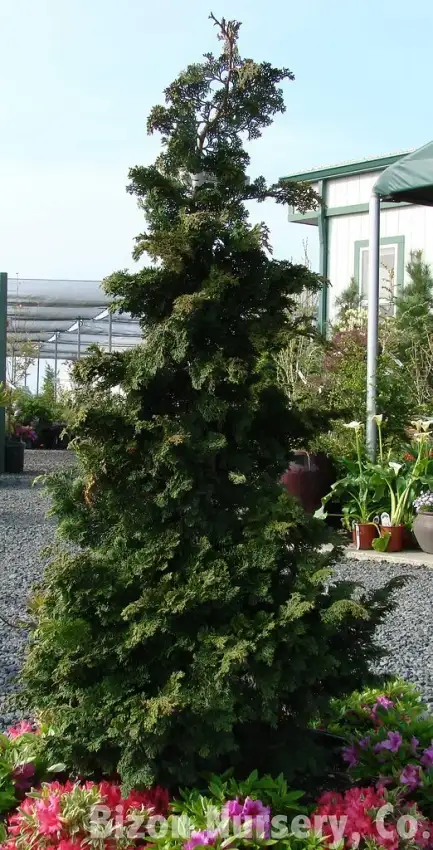
Wells Special is an upright Hinoki cypress with rich green foliage and gently arching branches. It grows more vigorously than many miniature Hinoki selections, making it useful where a substantial evergreen accent or screen is wanted. Its dense foliage and relatively narrow outline provide structure throughout the year without the bulk of a broadly spreading conifer.
At a glance
- Sun
- Full sun to part sun
- Size
- Height: 10–15 ft · Width: 4–6 ft
- Water
- Moist, well-drained soil
- Hardiness
- USDA zones 5–9
Sizes & prices
- #7Wells Special Falsecypress Staked Tree5'Call for price
Catalog updated September 8, 2026. This is not a live stock count; please call to confirm availability and price.
Ask about this plantSelect a section to expand.
Landscape use & tree form
- Form
- Upright with arching branches
- Use
- Hedge; privacy screen; ornamental specimen
- Growth rate
- Fast for a Hinoki cypress (grower description)
Resistance & tolerances
- Deer
- Protect from browsing where deer pressure is high; do not rely on this plant as a deer-proof screen.
- Drought
- The parent species has moderate drought tolerance after establishment; maintain moisture while young.
- Wet soil
- Moist soil with good drainage; do not treat as a standing-water plant.
Resistance is not a guarantee; deer and rabbits may browse any plant.
Seasonal interest
- Foliage
- Evergreen; rich green
- Cones
- Small orange-brown cones; species guidance.
Growing & care
- Soil
- Moist, fertile, well-drained soil; avoid waterlogged ground.
- Pruning
- Usually little pruning is needed. If shaping is necessary, prune in early spring to a leafy side shoot; avoid cutting into bare old wood.
- Issues
- Watch for bagworms and branch blight; poor drainage favors root rot.
Sources & photo credits
University of Minnesota Extension
Photo: MDBolin / Flickr, CC BY-SA 2.0; resized for web. · CC BY-SA 2.0
Image notes: Wells Special Hinoki cypress. Photo: MDBolin / Flickr, CC BY-SA 2.0; resized for web.
Reviewed September 22, 2026. Growing conditions vary by location.